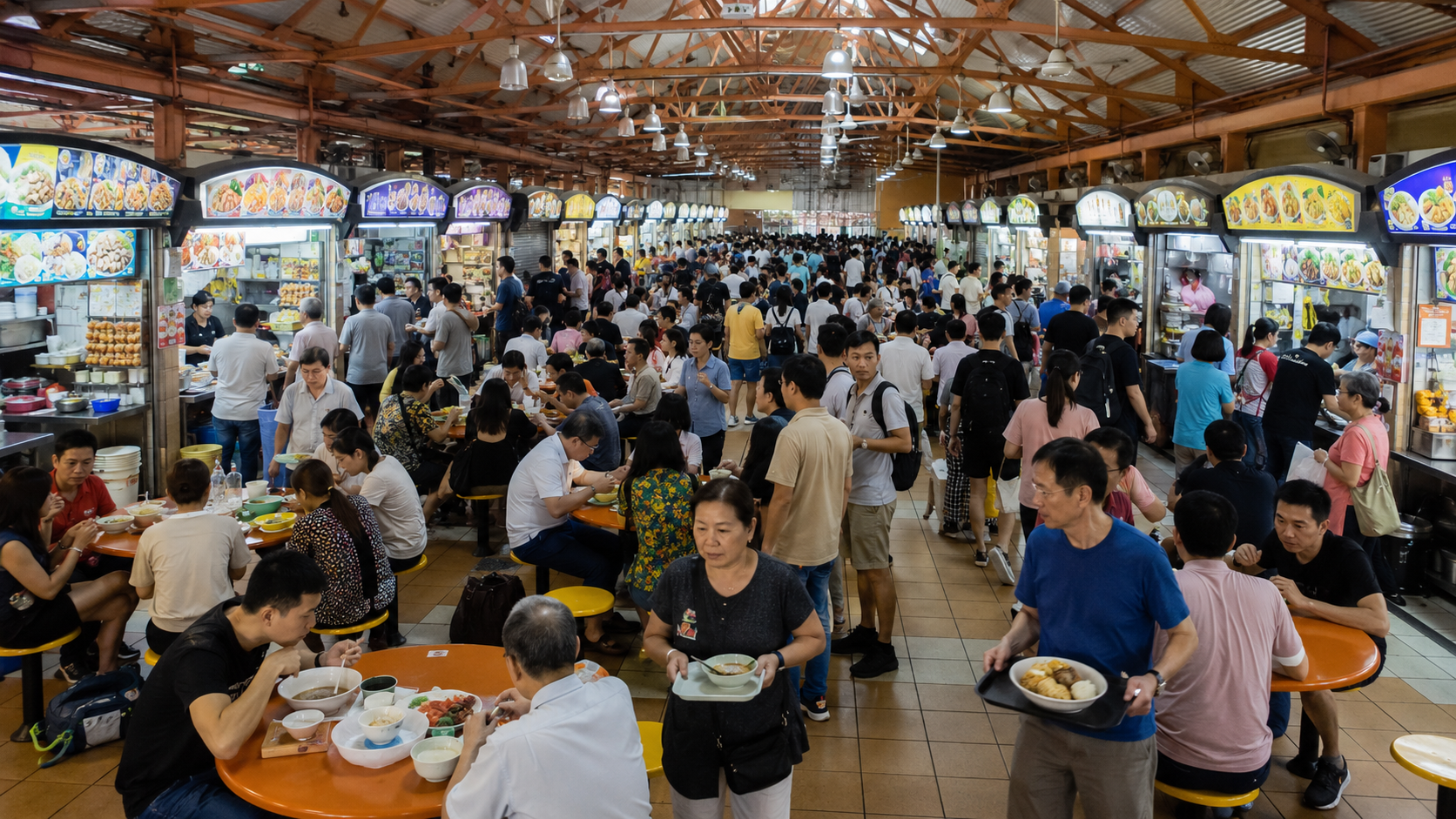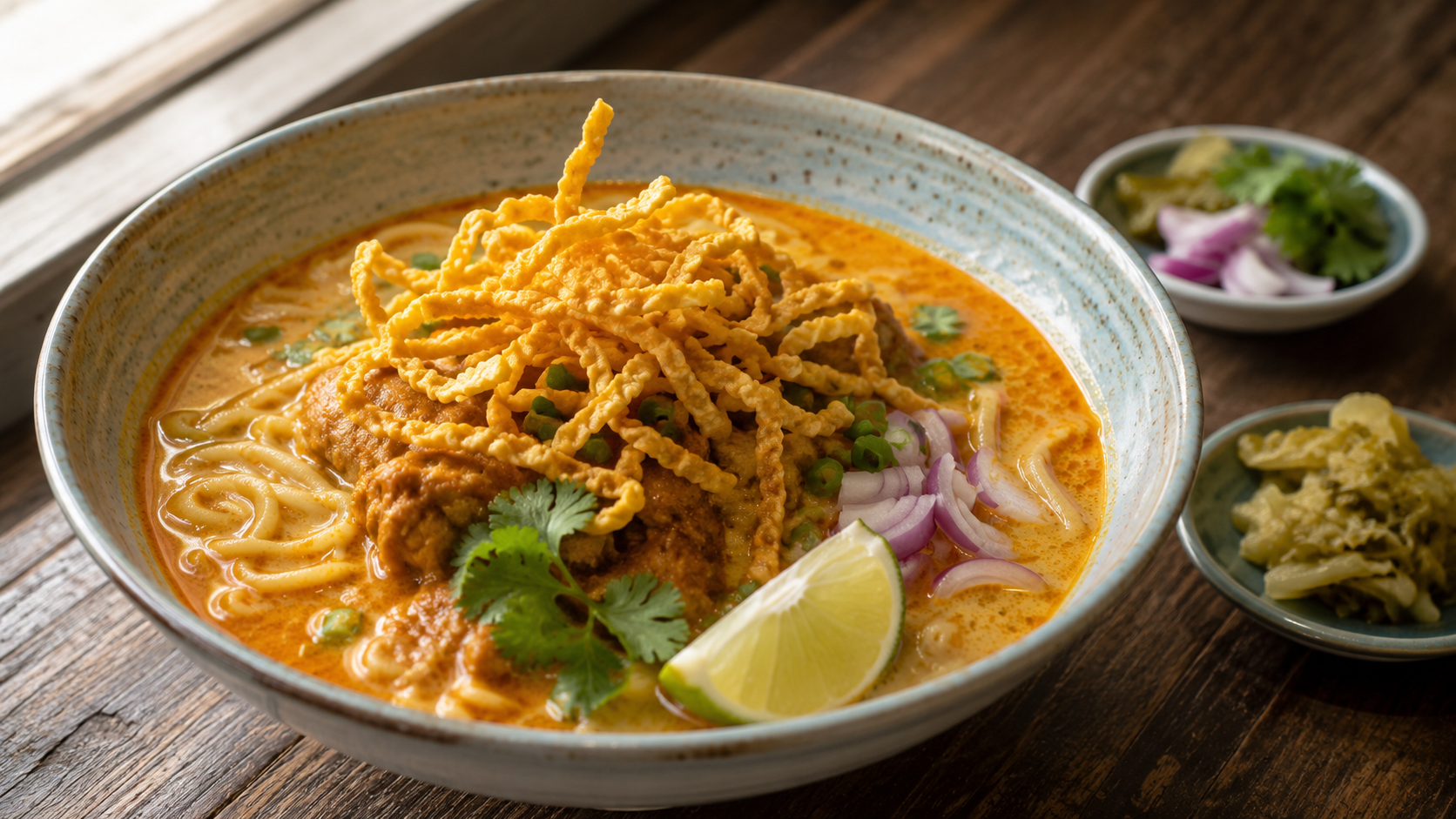
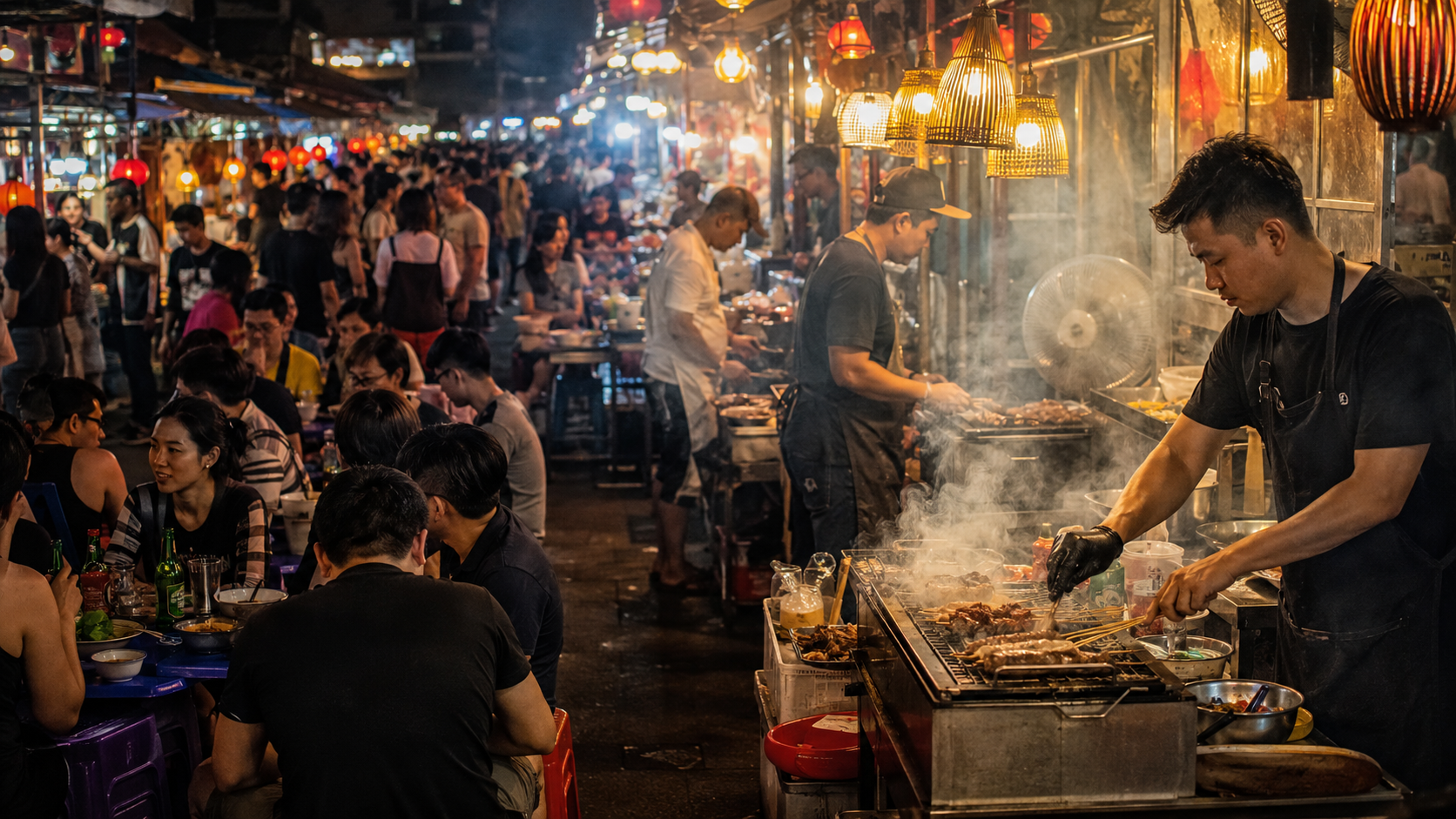
The best eating in Southeast Asia happens after sundown. Once the heat breaks and the neon flickers on, a parallel food economy emerges — one that operates from folding tables, charcoal grills, and carts wheeled into position with military precision. Night markets are not tourist attractions that happen to serve food. They are the backbone of how millions of people eat dinner.
Bangkok After Dark
Bangkok's night market scene has changed dramatically in the last five years. The old Rot Fai market at Ratchada, once a reliable sprawl of vintage shops and som tam stalls, closed when the MRT extension reshaped the neighbourhood. What replaced it is a more scattered landscape. Jodd Fairs near Ram Intra draws the social media crowd with its photogenic layout, but for actual eating, the less curated markets deliver more.
Head to Huai Khwang and you will find a stretch of vendors who have been working the same pitch for twenty years. The kuay jab here — rolled rice noodles in a peppery pork broth — is the kind of dish that makes you rethink what soup can be. Around the corner, a woman sells hoy tod, crispy mussel omelettes cooked on a flat griddle so hot the batter crackles the moment it hits the surface.
Penang: The Night Eating Capital
If Bangkok is the quantity capital, Penang is the quality one. Gurney Drive's hawker stalls have been feeding Georgetown's residents since the 1970s, and the competition between vendors has produced food of staggering consistency. The char kway teow here is not just good — it is the benchmark against which all other versions are measured. Cooked over charcoal in a seasoned wok that has not been scrubbed clean in decades, each plate carries a smokiness that no restaurant kitchen can replicate.
New Lane, or Lorong Baru, is where locals go when they want to eat seriously without the tourist markup. The duck rice stall in the middle of the row has a queue that starts forming at five in the afternoon. By seven, they are usually sold out. This is normal. The best night market food operates on a scarcity model — when it is gone, it is gone.
Chiang Mai's Quieter Scene
Chiang Mai's night markets have a different energy. The Sunday Walking Street along Ratchadamnoen Road gets the most attention, but the real eating happens at the smaller neighbourhood markets scattered through the old city. At Kad Manee, a weeknight market near Chang Phueak Gate, a vendor sells khao kha moo — braised pork leg over rice with pickled mustard greens — that rivals anything in Bangkok. She has been at the same spot for fifteen years, and her pork is braised for six hours until the collagen has completely broken down.
The northern Thai sausage vendors at the Saturday market on Wua Lai Road deserve special mention. Sai ua here is packed with lemongrass, galangal, and fresh turmeric, then grilled over low coals until the casing splits. Eaten with sticky rice and a pile of fresh herbs, it is one of the great simple meals in Thai cooking.
Rules for Night Market Eating
Arrive early. The best vendors sell out first. Bring cash in small denominations — nothing kills the flow of a night market queue like breaking a thousand-baht note for a forty-baht dish. Eat standing up or on a plastic stool; do not look for comfort, look for flavour. And if a stall has a queue of locals, join it. The crowd is never wrong.
Night markets are not restaurants. There is no menu engineering, no concept, no chef's vision statement. There is just a person who has been cooking one dish — maybe two — for most of their adult life, and has gotten extraordinarily good at it. That is the whole point.