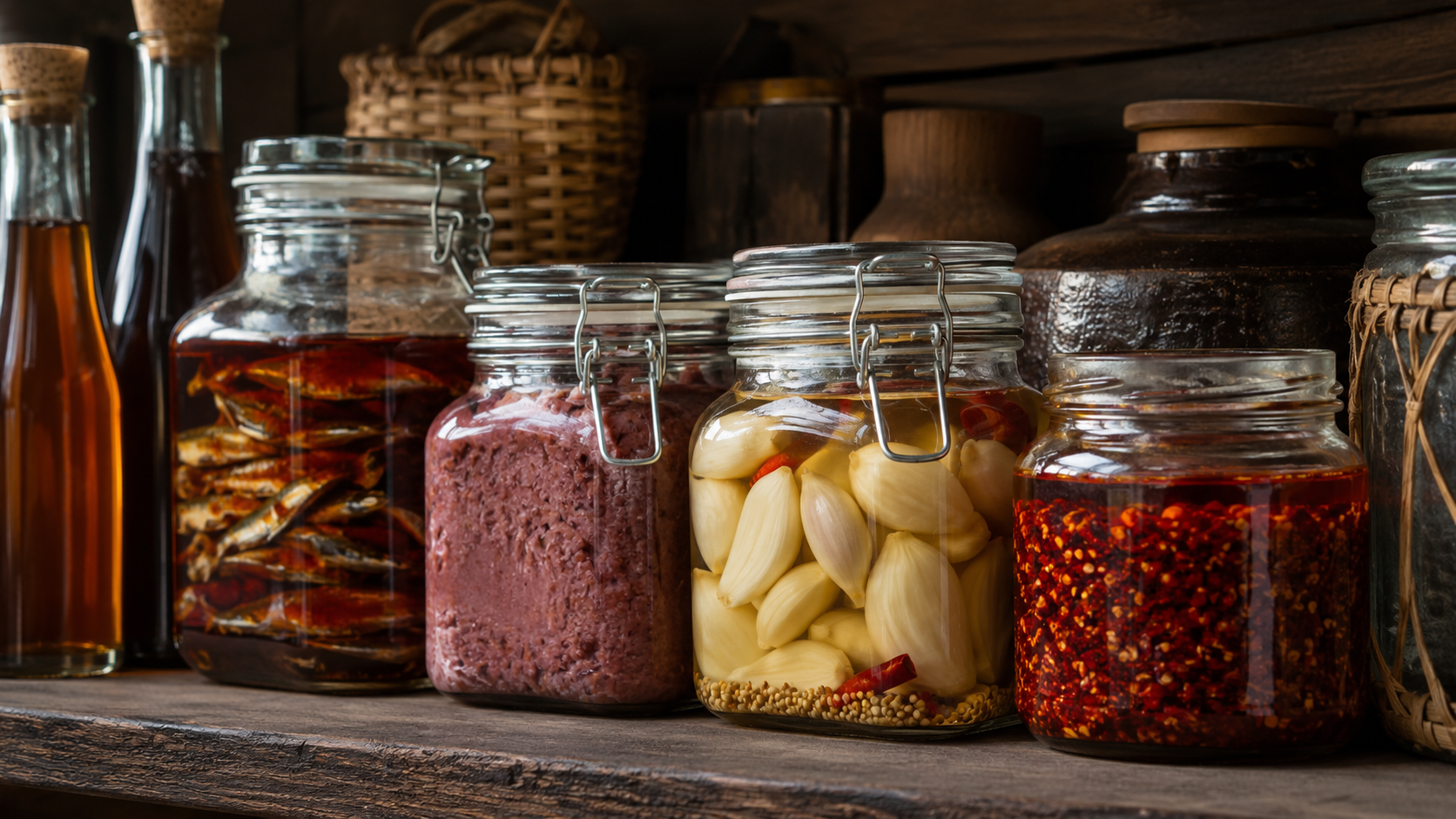
Open a bottle of good fish sauce — the real stuff from Phu Quoc or Rayong, not the supermarket version cut with sugar and hydrolysed protein — and what hits your nose is twelve to eighteen months of microbial labour. That amber liquid, clear as bourbon, is the product of anchovies and salt left to break down in earthenware jars under the tropical sun. It smells, frankly, aggressive. It also happens to be the single most important ingredient in Southeast Asian cooking.
Nam Pla: Thailand's Liquid Gold
Thai fish sauce, nam pla, is made from salted anchovies fermented in large ceramic or concrete vats. The process is deceptively simple: layer fish and sea salt in a ratio of roughly two to one, seal the vessel, and wait. Over months, the fish's own enzymes — proteases and lipases — break down the flesh into amino acids and peptides. The salt prevents harmful bacteria from taking hold while allowing halophilic microorganisms to do their work.
The first pressing, drawn off after twelve to eighteen months, is the premium product. It is dark, intensely savoury, and carries a complexity that cheap fish sauce cannot approach. Subsequent pressings, made by adding brine to the spent fish and re-fermenting, produce lighter, less complex sauces used for everyday cooking. The best Thai producers in Rayong province still use traditional methods and clay vessels, though industrial production now dominates the market.
Kapi: The Paste That Holds It Together
Shrimp paste — kapi in Thai, belacan in Malay, mam ruoc in Vietnamese — is arguably even more foundational than fish sauce. Made from tiny shrimp fermented with salt and sun-dried into a dense, purple-brown block, kapi is the starting point for most Thai curry pastes. Without it, a gaeng keow wan would taste flat and one-dimensional. The paste provides a deep, briny umami base that anchors the brighter flavours of lemongrass, galangal, and chilli.
The fermentation process differs from fish sauce in important ways. The shrimp are partially dried before salting, which concentrates their flavour and changes the microbial environment. The resulting paste contains not just free amino acids but also volatile compounds — dimethyl sulfide, trimethylamine — that give it that characteristic funk. These compounds mellow significantly when cooked, which is why raw kapi smells confrontational but a finished curry smells like dinner.
Tao Jiaw and the Soybean Tradition
Fermented soybean paste, tao jiaw, represents the Chinese influence on Thai fermentation. Used in stir-fries, dipping sauces, and the northern Thai relish nam prik tao jiaw, it brings a different kind of umami — malty, slightly sweet, with a grain-like depth that fish-based ferments lack. The beans are cooked, inoculated with Aspergillus mould, and left to ferment in brine. The process mirrors the early stages of Japanese miso production, though the end product is used differently.
In Thailand, tao jiaw is essential to dishes like pla sam rot — a whole fried fish topped with a sweet, sour, and salty sauce — and rad na, the gravy noodle dish that is a staple of Bangkok's Chinese-Thai restaurants. It provides a savoury backbone that rounds out the sharper notes of vinegar and chilli.
Why Fermentation Matters
What all these products share is time. You cannot rush fermentation. The chemical transformations that turn raw fish into nam pla or fresh shrimp into kapi require months of enzymatic activity, and there is no shortcut that produces the same result. Industrial producers who accelerate the process with hydrolysis or artificial enzymes create products that mimic the flavour but lack the depth.
Understanding fermentation is not academic — it is the key to understanding why the same dish can taste extraordinary in one kitchen and merely adequate in another. The condiments are the foundation. Everything else is built on top.